-
+86-18322274823


BOPP Pinch Bottom Bags MOQ: Small Batch vs Bulk Pet Food
BOPP Pinch Bottom Bags MOQ: Small Batch vs Bulk Pet Food
Key Takeaways
- What MOQ Really Means for BOPP Pinch Bottom Pet Food Bags: The minimum order quantity on a BOPP pinch bottom pet food bag is rarely a raw-material decision.
- Small Batch Runs: When Low MOQ BOPP Pinch Bottom Bags Make Sense: Short runs of BOPP pinch bottom bags exist for one reason: they let a pet food brand move at the speed of its market test without tying up capital in inventory it may never fill.
- Bulk Orders: How Volume Changes Unit Cost and Lead Time: The quoted unit price of a BOPP pinch bottom bag is never a pure raw-material figure — it carries several one-time costs that have to land somewhere.
- Matching Bag Format to Batch Size: PBOM, T-Shape and Step-Cut Options: Our BOPP laminated bags in PBOM construction pair a printed BOPP film with a PP woven core, so a 5–50kg dog food pack delivers full-surface shelf print alongside the tear and drop strength of a woven structure.
- MOQ Considerations Across 5-50kg Capacity and Multi-SKU Portfolios: Every bag dimension in a 5–50kg range demands its own production setup.
What MOQ Really Means for BOPP Pinch Bottom Pet Food Bags
The minimum order quantity on a BOPP pinch bottom pet food bag is rarely a raw-material decision. Polypropylene woven fabric, BOPP film and the laminated plies that fuse into the pinch weld are commodity inputs. What actually sets your MOQ is the tooling and machine time needed to convert those inputs into a printed, dimensionally stable bag that runs cleanly on your filling line. JTFPACK manufactures bopp pinch bottom bags moq from its base in Tianjin, China, under ISO 9001 quality management.
The Fixed Costs Buried Inside a Printed BOPP Bag Order
Every custom order carries setup work that is consumed once, regardless of run length:
- Cylinder or plate engraving — each print colour requires its own engraved cylinder, so a four-colour photographic kibble design multiplies that cost four times before a single bag is printed.
- Print registration tuning — BOPP lamination demands tight registration across the woven substrate, and the make-ready window is fixed.
- Lamination setup — coat weight, nip pressure and curing on BOPP laminated PP woven and PBOM constructions are dialled in per order.
- Machine run-in — bag making, gusset forming and step-cut punching each need their own adjustment time.
This is why a stock or two-colour design can often be produced at a far smaller quantity than a multi-colour photographic pet food design. Bag dimensions, gusset style and bottom seal type add their own setup steps, so every change from the standard spec pushes the practical minimum upward. Our BOPP laminated PP woven pinch bottom bags are quoted against a defined specification so that minimum stays predictable.
MOQ vs. Minimum Practical Run on Automated Filling Lines
MOQ should never be evaluated in isolation. A quantity that looks efficient on a printer’s cost sheet can create excess changeover downtime on a 5–50 kg automated line, where every reel change stops the sealer and forces the pinch weld parameters to be re-set. Remember that the closure is heat-welded: after filling, the pre-formed step-cut top fold is folded and the laminated plies are melted into a seamless permanent weld, which has to be validated at your line speed. The right figure balances print setup against annual throughput — review our Pinch Bottom Bags range as a starting point, and see how closure behaviour is covered in BOPP pinch bottom bags for automated filling lines. All production runs under our ISO 9001 quality management system.
Small Batch Runs: When Low MOQ BOPP Pinch Bottom Bags Make Sense
Short runs of BOPP pinch bottom bags exist for one reason: they let a pet food brand move at the speed of its market test without tying up capital in inventory it may never fill. When demand is unproven, the smaller first order is often the cheaper decision once the cost of unused stock is counted.
Typical Situations Where Short Runs Beat Bulk Pricing
We see low-MOQ orders concentrate in four scenarios:
- New SKUs in test markets — a single recipe trialled in two or three regions, where sell-through data matters more than unit cost.
- Limited-edition formulas — seasonal proteins or functional blends with a defined run and no reorder committed.
- Subscription-box sizes — 5 kg to 10 kg formats filled in cycles, where the bag dimension, not the volume, is the constraint.
- Trial packs — 1 kg to 5 kg sample bags used to open retail or distributor conversations.
In every case the closure performs identically: the pre-formed step-cut top fold interlocks and is heat-welded in a pinch sealer, melting the laminated BOPP plies into a permanent seamless seam.
Managing Cost Per Bag on a Small Order
Expect a higher unit price on a short run. Setup — print make-ready, plates, sealer calibration — is fixed, so it spreads across fewer bags. That per-bag gap is a function of quantity, not bag quality: a 10,000-bag order and a bulk order can use the same BOPP/PP woven construction and the same heat-welded closure.
The levers that move a small-batch quote most:
- Trimming print colours, or moving to a simpler two-colour design.
- Standardising bag dimensions across several SKUs, so one setup serves multiple formulas — our 25 kg and 50 kg PP woven bags for food and feed often cover a whole range.
- Building the trial around a proven pinch bottom bag construction and reserving custom print for the scale-up.
Artwork risk is the quieter saving: revising a design after a 10,000-bag run costs far less to absorb than after a bulk commitment. Our ISO 9001 quality management system covers dimensional checks and weld integrity, with finished sacks referenced against ASTM D5276 drop-test practice for loaded bags before a run is signed off.
Bulk Orders: How Volume Changes Unit Cost and Lead Time
Where the Savings Actually Come From
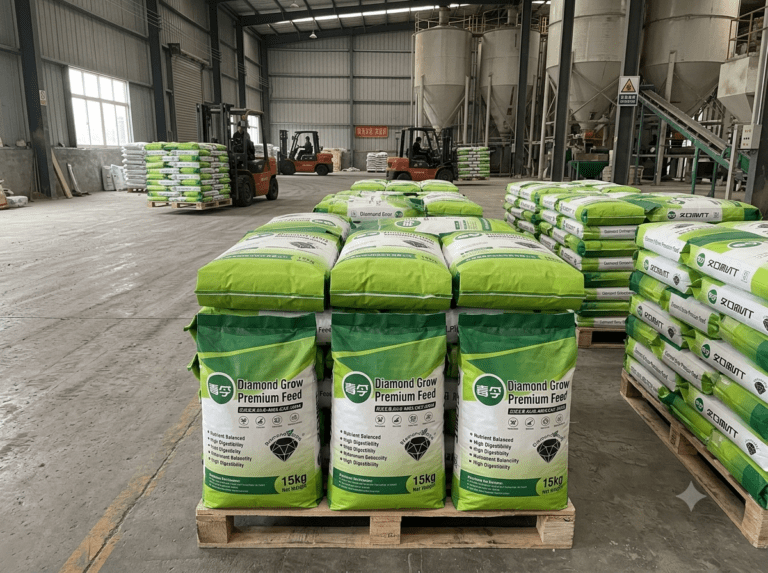
The quoted unit price of a BOPP pinch bottom bag is never a pure raw-material figure — it carries several one-time costs that have to land somewhere. Cylinder engraving for gravure print, BOPP film lamination setup, ink and registration calibration, and the tooling behind the T-shape step-cut top fold are all fixed. Spread across 5,000 bags, those costs dominate the quote; spread across 150,000, they nearly disappear. The larger effect is scheduling. A long, uninterrupted run on our woven PP and BOPP lamination lines means fewer changeovers, fewer colour-matching cycles, and less start-up scrap per thousand bags — and that is where bulk pricing genuinely originates. It applies across formats, from 10kg/20kg food bags to step-cut BOPP PBOM dog food bags.
Lead Time and Storage Realities of High-Volume BOPP Bag Orders
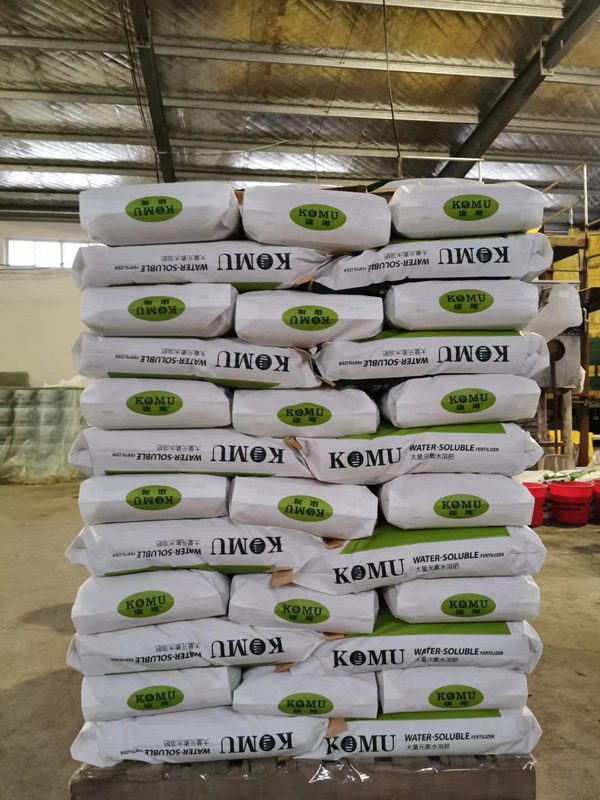
Volume buys price, not speed. A 100,000-bag order consumes substantially more press time and requires more freight planning, so negotiate lead time at order confirmation rather than assuming it scales proportionally from a sample run. Bulk also locks artwork: final design, dimensions, and bottom style must be approved before production starts, because revisions after the cylinders are cut are costly or impossible. Seal integrity on finished bags is verified through ASTM F88 tensile seal-strength testing instead of visual inspection alone, and our quality management follows ISO 9001. Plan the warehouse as carefully as the press: BOPP-laminated bags are moisture-proof by construction, yet storage conditions still influence print gloss and weld integrity before filling — keep pallets dry, off bare concrete, and clear of temperature swings. Review the full Pinch Bottom Bags range to match capacity and bottom style to your filling line.
Matching Bag Format to Batch Size: PBOM, T-Shape and Step-Cut Options
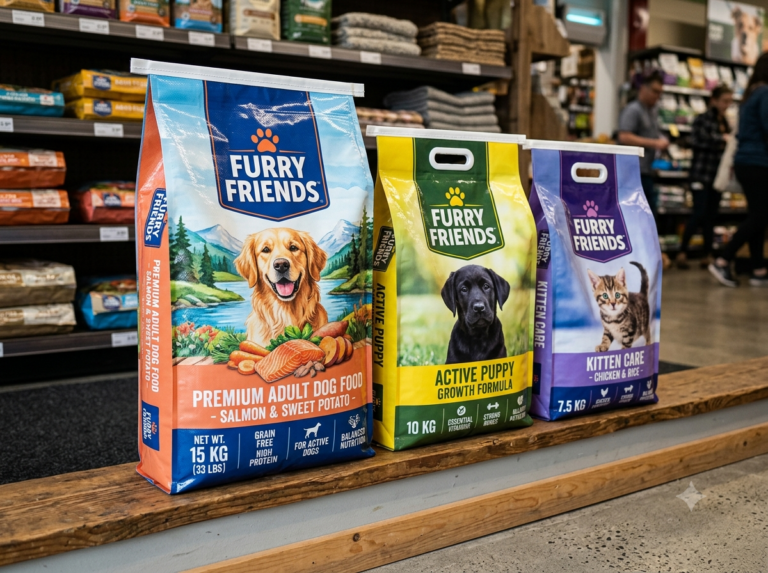
BOPP PBOM Dog Food Bags (T-Shape) for Branded Retail Packs
Our BOPP laminated bags in PBOM construction pair a printed BOPP film with a PP woven core, so a 5–50kg dog food pack delivers full-surface shelf print alongside the tear and drop strength of a woven structure. The T-shape PBOM format is engineered for retail-facing pet food: the pre-formed step-cut top fold is folded and heat-welded in a pinch sealer, melting the laminated plies into a permanent seamless weld, and the T-fold expands into a clean rectangular block once filled. Brands specifying a PP*STAR-style profile use our 10kg 20kg poly bags for food customized PP*STAR st as the reference build for this shelf-facing format.
Step-Cut Pinch Bottom Bags for High-Speed Automated Filling
Step-cut construction keeps automated lines running. The stepped corner profile engineered into the top fold gives the bag a defined opening geometry, so suction cups and grippers index it consistently at the filler and the pinch sealer closes on a repeatable fold line — fewer misfeeds, fewer rejects, and less downtime per shift. Seal integrity is checked against ASTM F88 seal-strength test practice within our ISO 9001 quality management system.
Format choice directly moves BOPP pinch bottom bags MOQ. A standard step-cut construction is the lower-minimum route; a fully custom T-shape with multi-colour BOPP print adds cylinder and print setup cost and raises the minimum accordingly. Send us your pack weight, print requirement and filler type, and we will quote both constructions side by side.
MOQ Considerations Across 5-50kg Capacity and Multi-SKU Portfolios
Why One MOQ Does Not Fit Every Bag Size in the Range
Every bag dimension in a 5–50kg range demands its own production setup. A 5kg pack and a 25kg pack use different PP woven tube widths, different BOPP lamination web widths, different step-cut top fold profiles, and separate gravure print cylinders. Because cutting, sealing and printing are configured per size and per design, our MOQ is quoted per specification rather than as a single blanket figure — a 10kg and a 25kg run are effectively two production jobs even when the artwork is identical. For reference, finished bags are typically verified against standard test methods such as ASTM D1709 (dart impact) and ASTM D5034 (tensile strength) to confirm that the specified laminate and woven structure hold up at each capacity tier, all produced under ISO 9001 quality management.
Splitting a Bulk Commitment Across Several Pet Food SKUs
If your portfolio includes multiple flavours or formulations, ask how the quantity is counted before you commit. A single large volume allocated across several SKUs sometimes reaches bulk pricing more efficiently than several separate small orders, because the supplier can sequence the runs together — but only if the MOQ is calculated on combined volume rather than per SKU.
You can reduce the total number of setups required in three practical ways:
- Consolidate sizes — standardise on fewer bag dimensions across the range where the fill weight allows.
- Share print elements — use common branding, panel layout and colour plates across a flavour range, changing only the flavour block.
- Plan artwork rollouts in advance — stagger launches onto scheduled runs instead of ordering each design separately.
We manufacture BOPP laminated PP woven bags, pinch bottom bags and BOPP PBOM pet food packaging across the 5–50kg capacity range used in pet food, animal feed and fertilizer. Our BOPP pinch bottom woven polypropylene bags are heat-welded in a pinch sealer, folding the pre-formed step-cut top and melting the laminated plies into a seamless permanent weld — a closure that stays square-bottomed and stackable after filling.
Checklist: Questions to Ask Before Committing to a BOPP Bag MOQ
Specification Details That Move the Minimum
Before you accept any BOPP pinch bottom bags MOQ figure, confirm exactly what the number counts. Some suppliers quote on finished bags, others on printed bags, and many apply the minimum per size and per design — so two artwork variants can double your commitment. Ask precisely: is this 10,000 bags total, or 10,000 per SKU?
Then lock the filling specifications against your own line. Bag dimensions, gusset depth, top opening width, and the step-cut top fold must suit your automated filling equipment before quantity is finalised. Our 20kg–25kg BOPP pinch bottom bags run in BOPP-laminated PP woven construction from 5kg to 50kg capacities, with closures heat-welded in a pinch sealer rather than glued — a distinction that matters if your sealer is calibrated to a specific ply thickness.
Request the dimensional tolerance and seam strength data in writing; reference test methods such as ASTM D882 for tensile properties or ASTM D1709 for impact resistance so both parties measure the same way. Our production is managed under ISO 9001, and we will supply specification sheets supporting that framework.
Commercial Terms to Confirm in Writing
Ask whether plate or engraving costs are one-time, reusable on reorders, and who holds the artwork files if you switch suppliers. Clarify first-run lead time versus repeat-run lead time, and whether the first order includes a sampling or print-approval stage — that stage alone can add weeks.
- Does the MOQ apply to natural/unprinted bags separately from printed runs?
- Are cylinder fees credited against future orders?
- Who approves colour proofs, and at what stage?
For a broader view of construction options, see our pinch bottom bags range, and check the guide to PP woven bag types before you sign.
Technical Specifications at a Glance
| Parameter | Specification |
|---|---|
| Capacity range | 5 kg – 50 kg (11 lb – 110 lb) |
| Construction | BOPP film laminated to PP woven or film core |
| Closure | Heat-welded pinch bottom with pre-formed T-shape step-cut fold |
| Printing | Up to 10-colour reverse gravure (gloss, matte or spot-matte) |
| MOQ | 5,000 pcs standard / 500–1,000 pcs FIBC |
| Lead time | 7–15 days standard, 15–25 days custom print |
| Quality system | ISO 9001 |
| Palletising | Bales on pallets, stretch-wrapped for export |
Frequently Asked Questions
What is the typical MOQ for custom printed BOPP pinch bottom pet food bags?
Minimum order quantities for custom printed BOPP pinch bottom bags are driven mainly by print setup — flexo plates or rotogravure cylinders — rather than by the bag construction itself. Because that setup cost is fixed, printed orders generally begin in the low thousands of pieces, with digital or short-run options for smaller volumes. Exact MOQ depends on bag size, gusset depth, film structure and print coverage, so send us your specification and we will confirm the figure.
Is it cheaper to order one large bulk run or several small batches across a year?
A single bulk run almost always delivers the lowest unit price, because print setup, lamination changeover and machine scheduling are spread across more bags. Several smaller batches cost more per bag but reduce inventory carrying cost and lock-in, and let you revise artwork or barrier structure mid-year. The break-even point depends on annual volume, warehouse space and SKU stability. We can quote both structures side by side so you can compare landed cost.
Does the MOQ change between BOPP PBOM T-shape bags and step-cut pinch bottom bags?
The MOQ is largely unaffected by bottom style. Both BOPP PBOM T-shape bags and step-cut pinch bottom bags are printed from the same plate or cylinder set, so setup — not the fold — determines the entry volume. Unit price does differ: T-shape formats generate more trim waste and consume slightly more film, while step-cut bags fold flatter and palletise more densely for freight savings.
Can I order a small trial batch with full custom printing before committing to bulk?
Yes. We can structure a trial run with full custom printing, typically quoted at or slightly above the standard MOQ, or produced digitally where the artwork permits. A sub-MOQ trial carries a higher unit cost because setup is not amortised across a large run and machine time is booked in fixed blocks. Trials remain the correct way to validate filling-line performance before a bulk commitment.
How do 5kg and 25kg bag sizes affect MOQ and unit price?
Bag size shifts both figures. A 5kg bag consumes less film per unit, so an MOQ measured in pieces represents a modest film tonnage — practical for launching or testing a new SKU. A 25kg bag uses considerably more material per unit, so the same piece count becomes a much larger production run with a higher per-bag price, though cost per kilogram of packed product falls.
Are BOPP pinch bottom bags compatible with automated filling lines for 5-50kg pet food?
Yes. Pinch bottom bags are engineered for automated filling. BOPP PBOM T-shape bags open reliably on pinch bottom open mouth equipment across the 5–50kg range, and the stepped edges are folded and heat-welded in a pinch sealer — melting the laminated plies into a permanent, seamless closure with no adhesive or tape. Gusset geometry, film slip and seam width are specified against your filler.
Send us your bag dimensions, target fill weight and print coverage, and our team will return a free quote with MOQ options across both step-cut and T-shape formats — or arrange a sample pack for a trial on your own filling line.