-
+86-18322274823


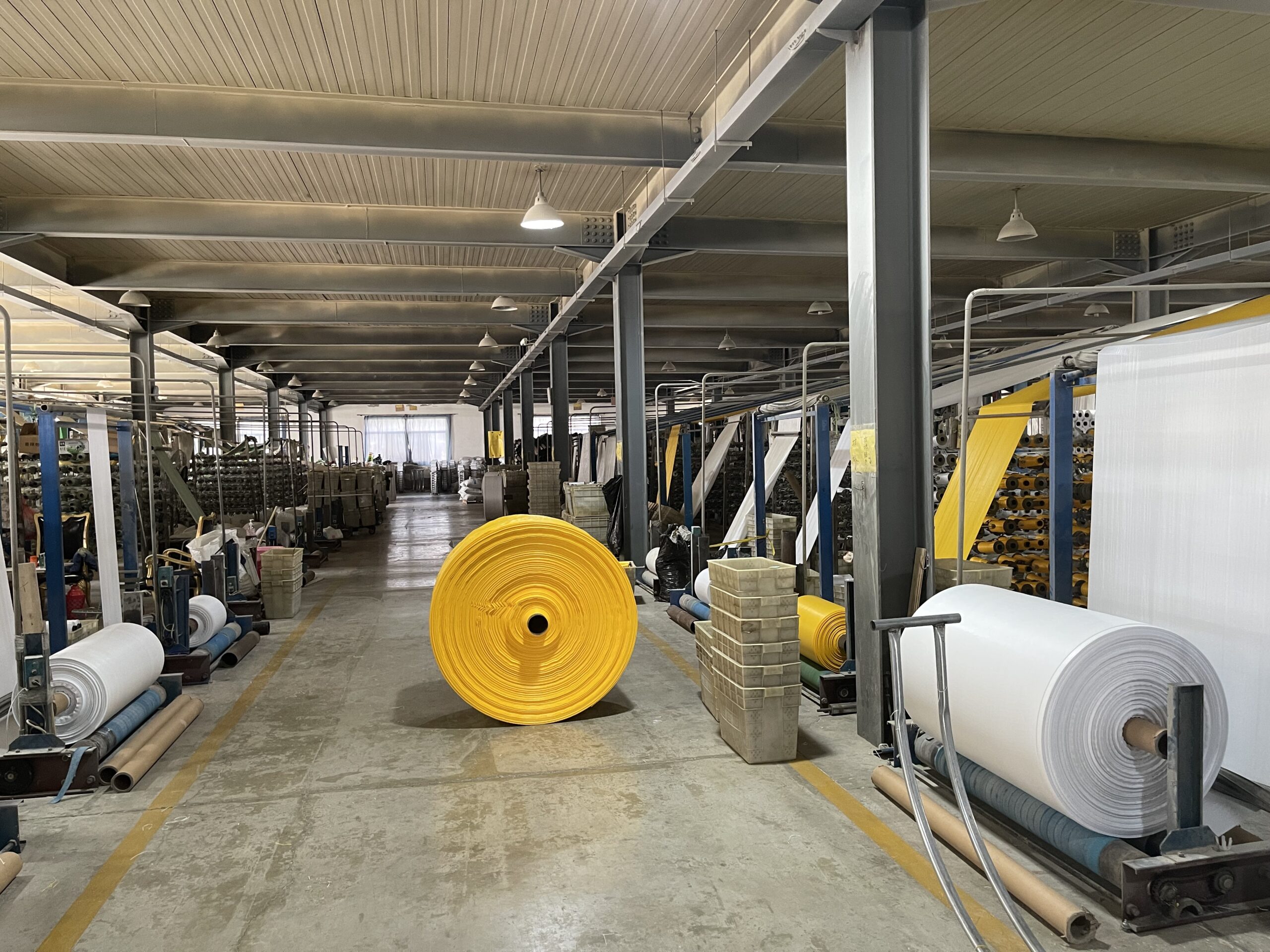
Moisture-Proof Step-Cut Pinch Bottom Bags for Chemical Storage
Moisture ingress is one of the most underestimated cost drivers in the chemical, fertilizer, and feed supply chains. A bag that performs perfectly in a dry warehouse can fail within weeks in a port container or a tropical distribution center, turning free-flowing granules into caked blocks and triggering rejections, rework, and lost customers. For buyers sourcing packaging for humid climates, moisture-proof step-cut pinch bottom bags have become a benchmark solution—combining a pre-formed T-shape step-cut top fold with a pinch bottom closure to deliver a tight, squared-off heat-welded seal that resists moisture wicking where conventional bags fail. This article examines why humidity is so destructive to chemical and mineral products, how step-cut pinch bottom construction blocks moisture ingress, and how procurement teams can specify, test, and source these bags with confidence.
Why Humid Climates Threaten Chemical and Mineral Integrity
Hygroscopic products absorb moisture from the surrounding air whenever ambient humidity exceeds the equilibrium moisture content of the material. Fertilizers such as ammonium nitrate, urea, and NPK blends are notoriously sensitive; feed ingredients like soybean meal, fish meal, and distillers’ grains readily pick up moisture and become prone to mold; and industrial minerals including soda ash, calcium chloride, and certain salts can deliquesce or fuse into solid masses. The consequences are measurable and expensive:
- Caking and clumping reduce flowability, clog dosing equipment, and force manual break-up labor or outright rejection at the customer’s plant.
- Chemical degradation can alter assay values, dissolve active ingredients, or trigger unwanted reactions—particularly in blended fertilizers where moisture migration between granules promotes salt exchange and hardening.
- Microbial growth in feed and organic materials creates spoilage, off-odors, and potential mycotoxin risk.
- Weight and appearance changes undermine brand trust; a bag that arrives stained, swollen, or rock-hard generates complaints and claims regardless of the product’s original quality.
The economics are stark. In humid regions, poorly protected fertilizer or feed can lose a meaningful percentage of saleable value per shipment, and the downstream costs—returns, replacement freight, customer credits, and damaged relationships—often dwarf the packaging price difference between a standard bag and a true moisture-barrier construction. Humidity also fluctuates: day–night temperature swings cause condensation inside containers and warehouses, meaning protection must address not only steady vapor pressure but also transient wetting at bag surfaces and closures.
Where does moisture actually get in? Through the film or wall material, through the closure seams, and through bag ends that are exposed, abraded, or poorly sealed. This is precisely where bag architecture matters—and where the step-cut pinch bottom design earns its place.
How Step-Cut Pinch Bottom Construction Blocks Moisture Ingress
A pinch bottom bag is formed from a flat tube with one end left open for filling; after filling, the open end is heat-sealed in a dedicated pinch sealer: after filling, the bag top enters the machine, which folds the stepped corner profile and applies heat, melting the laminated plies together into a seamless, permanent weld that forms a strong, squared-off bottom. The “step-cut” refers to the pre-formed T-shape step-cut top fold—a stepped corner profile engineered into the bag top that interlocks when folded and heat-sealed, creating a tight, squared-off closure. Together, these features address moisture ingress at the two weakest points in any sack: the ends and the closure.
A tight, squared-off seal at the bag ends
Conventional sewn or folded ends leave needle holes, folds, and exposed edges that act as wicking channels. The pre-formed T-shape fold combined with a properly heat-welded pinch bottom closure creates a continuous sealed edge with minimal exposed material. Because the closure is bonded across the full bag width—rather than stitched—there are no perforations for water vapor to exploit. The squared-off bottom also allows bags to sit flatter and more uniformly on the pallet, reducing the creasing and abrasion that open micro-pathways in the film over time.
Reduced bag-end exposure and better pallet stability
Step-cut geometry is an often-overlooked moisture defense. The pre-formed T-shape fold ensures precise fold alignment during heat sealing, creating a continuous, interlocked weld. The resulting squared-off bottom also allows bags to sit flatter and more uniformly on the pallet, reducing creasing and abrasion. Fewer protrusions mean fewer surfaces rubbing against pallets, stretch film, and neighboring bags during handling and transport—abrasion being a common cause of pinholes that compromise barrier films. A stable pallet also stacks more squarely in containers, reducing contact with condensation-prone container walls and floors.
Structural integrity under load
Moisture protection is only meaningful if the bag survives handling. Pinch bottom bags are engineered for heavy-duty loads—JTFPACK’s range covers 5–50kg capacities—and the pinch bottom closure distributes stress across the full seam rather than concentrating it at stitch points. That strength matters in humid conditions, where paper and film layers can soften and where a ruptured seam quickly becomes a moisture entry point. For operations running automated filling lines, the consistent, squared-off shape of step-cut pinch bottom bags also supports reliable bag opening, filling, and closing with fewer misfeeds and jambs than flimsier sack formats.
Compatibility with barrier liners and coatings
The pinch bottom format accommodates multi-layer wall constructions—film liners, metallized layers, and barrier coatings—without compromising closure performance. This is essential: the closure must seal through or around the barrier layer, not just the outer wall. A well-engineered moisture-proof step-cut pinch bottom bag is designed as a system, where the wall, liner, and closure are validated together rather than assembled from mismatched components.
Material Selection: Films, Coatings, and Barriers That Perform in High Humidity
No single material is right for every product. Barrier performance is typically expressed as WVTR (Water Vapor Transmission Rate)—grams of vapor passing through a defined area per day under specified temperature and humidity conditions. Lower WVTR means better protection, and the target WVTR should be set by the sensitivity of the product and the expected exposure time, not by generic “moisture-proof” claims.
Polyethylene (PE) film liners
PE liners are the workhorse of moisture protection in industrial sacks. Low-density and linear low-density PE films offer good moisture barrier at moderate cost, with the added benefit of heat-sealability. For fertilizers and minerals with moderate sensitivity, a PE liner laminated to a PP woven or paper outer wall provides a practical balance of strength, barrier, and cost. Thicker liners improve WVTR but add weight and cost, so liner gauge should be matched to the product’s critical moisture threshold.
Metallized layers
Metallized films (typically metallized PET or BOPP) deliver substantially lower WVTR than standard PE by adding a thin aluminum layer that reflects and blocks vapor transmission. These are appropriate for highly hygroscopic products—certain specialty chemicals, sensitive feed premixes, and premium fertilizer blends—where even small moisture gains cause caking or degradation. Metallized constructions must be handled carefully to avoid flex-cracking, which is why the outer wall’s toughness and the bag’s handling profile matter as much as the barrier layer itself.
Barrier coatings and BOPP lamination
For brands that also need print quality and shelf presence, BOPP laminated PP woven bags combine a woven PP structural core with a BOPP film surface that accepts high-quality graphics while contributing to moisture resistance. BOPP also improves scuff resistance, protecting the barrier beneath. Where a paper-like appearance or additional barrier is desired, moisture-barrier coatings can be applied to the outer wall. JTFPACK’s BOPP pinch bottom bags (PBOM) are engineered to pair these printed surfaces with pinch bottom closure integrity, and the same lamination technology extends to BOPP laminated PP woven bags for applications needing woven strength with a premium finish.
Choosing by product sensitivity
A practical selection framework:
- Low sensitivity (short exposure, dry destination): PE-lined PP woven or paper pinch bottom bags with standard closure.
- Moderate sensitivity (fertilizers, general minerals, feed): heavier PE liner or coated construction, validated seal, step-cut profile for pallet stability.
- High sensitivity (premium blends, hygroscopic chemicals, specialty feed): metallized or high-barrier laminate with PE sealant layer, full seal-continuity validation, and accelerated humidity testing.
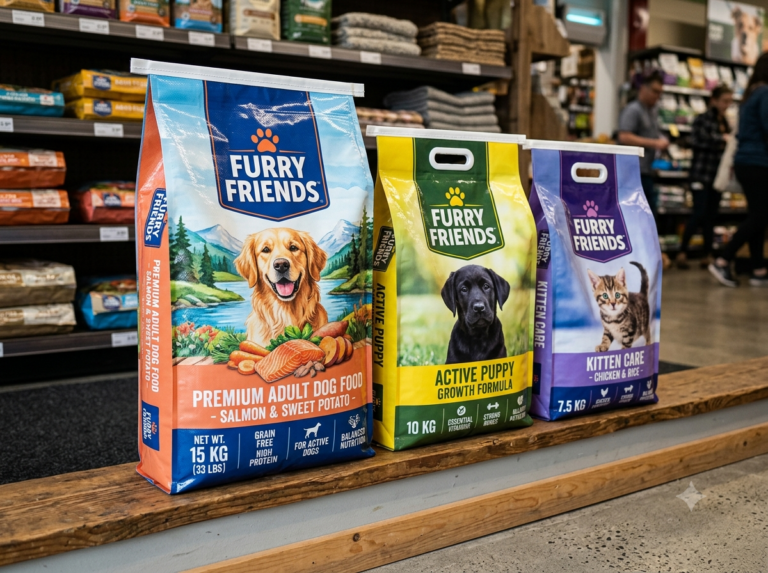
For pet food and feed applications where aroma retention and rancidity control matter alongside moisture, BOPP PBOM dog food bags (T-shape) demonstrate how barrier and closure design can be tailored to a specific product category.
Matching Bag Specifications to Your Product: Fertilizers, Minerals, and Feed Ingredients
Specification should begin with the product, not the bag. Three questions drive the decision: How hygroscopic is the material? How long and under what conditions will it be stored and shipped? And what moisture level is unacceptable at the customer’s receiving dock?
Fertilizers
Urea and ammonium nitrate are highly hygroscopic and prone to caking under pressure and humidity; NPK blends vary by formulation but generally benefit from strong vapor barriers and stable pallets. Recommended direction: PE-lined or metallized step-cut pinch bottom bags in the 25–50kg range, with heat-welded closure validated for seam continuity, plus pallet stability to minimize bag-end abrasion. For granular products, consider the bag’s ability to vent residual heat after filling without admitting ambient moisture—an area where liner and closure design must be coordinated.
Minerals and industrial chemicals
Soda ash, salts, and mineral powders vary widely in sensitivity. Deliquescent materials demand high-barrier constructions; inert minerals may need only moderate protection plus mechanical durability. Because many minerals are dense and abrasive, the outer wall’s puncture and abrasion resistance is critical—an abraded barrier is a failed barrier. Heavy-duty pinch bottom bags with reinforced T-shape step-cut folds are appropriate here, and the squared-off shape supports dense, stable palletizing in bulk storage.
Feed ingredients and finished feed
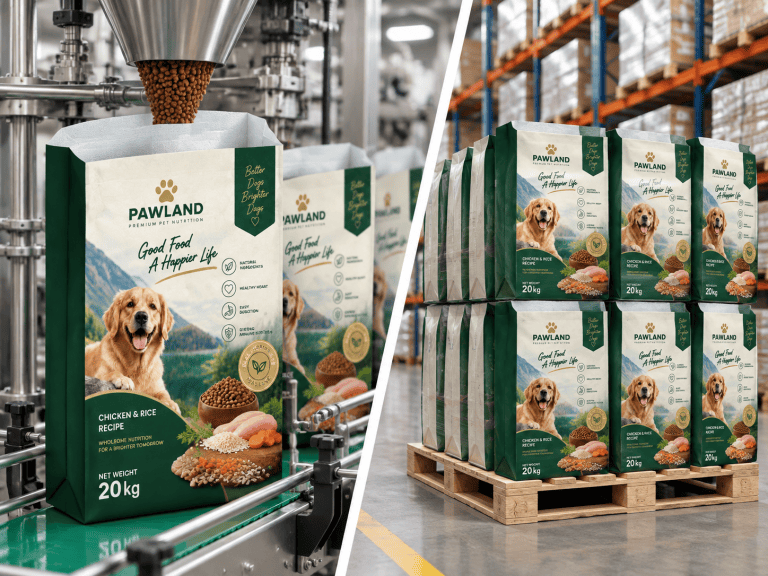
Feed combines moisture sensitivity with microbial risk and, for finished pet food, aroma and fat-stability concerns. Animal feed packaging typically calls for PE-lined or BOPP-laminated constructions with strong seals; extruded pet food benefits from bags that resist fat migration and odor loss. For cat and dog food brands, pet food packaging solutions can be specified with printed BOPP surfaces for shelf impact and barrier layers tuned to the product’s fat content and expected shelf life.
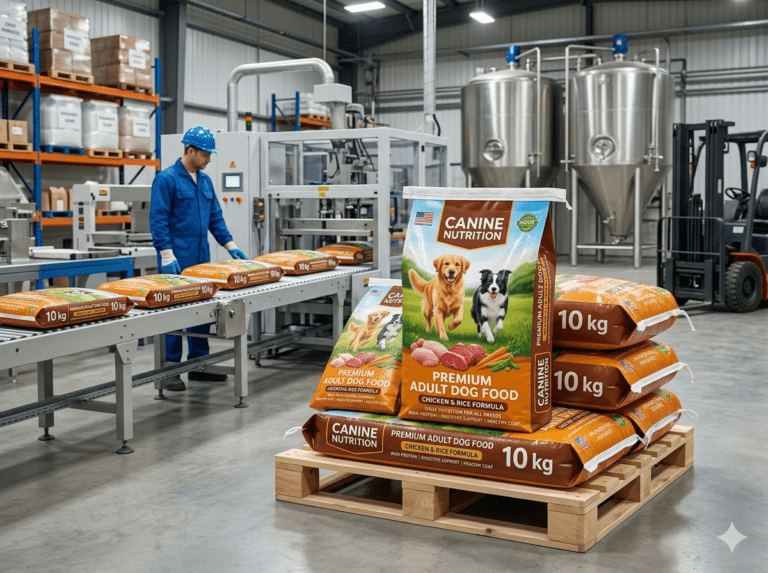
Across all three categories, capacity and line compatibility matter: JTFPACK’s step-cut pinch bottom bags are available from 5kg to 50kg, are compatible with automated filling lines, and can be customized in dimensions, liner gauge, print, and closure weld profile to match a specific product and packing operation.
Closure Integrity and Handling: Where Moisture Protection Is Won or Lost
A bag can have an excellent barrier wall and still fail at the seam. Pinch bottom closures are heat-welded, not glued: the sealer folds the stepped edges and melts the plies together, so the weld must be continuous across the full width and strong enough to survive filling stress, pallet compression, and transport vibration. The most common failure modes are:
- Gaps and channeling: incomplete weld coverage creates direct vapor pathways, especially at the corners where plies overlap.
- Contamination: dust, product residue, or moisture on the sealing area prevents proper welding.
- Material mismatch: films not formulated for heat sealing may under-weld or burn through; the laminate structure must be engineered for the weld process.
- Improper fold geometry: misaligned folds at the T-shape step-cut top leave exposed edges that wick moisture.
Validation should include seal strength testing (peel and shear), visual and dye-penetration checks for continuity, and burst testing under load. On the line, operators should monitor sealing temperature, pressure, and dwell time, and keep sealing jaws clean. For automated filling operations, bag opening and presentation must be consistent—step-cut pinch bottom bags are designed for this, but supplier and packer should align on bag dimensions, gusset configuration, and stack orientation.
Handling after filling matters too. Bags should be palletized squarely, stretch-wrapped to limit movement, and stored off damp floors. In humid warehouses, avoid stacking directly against walls where condensation forms, and rotate stock so barrier performance is not tested beyond its validated shelf life.
Testing and Compliance: Verifying Moisture Barrier Performance Before You Commit
Material claims are not evidence. Procurement teams should require test data and, ideally, independent verification before scaling a packaging change. Key tests include:
- WVTR testing of the finished construction (not just the film datasheet), reported with test conditions (temperature, relative humidity) and units so results are comparable across suppliers.
- Seal integrity testing: peel strength, burst strength, and dye-penetration or vacuum leak testing of the pinch bottom closure.
- Accelerated humidity trials: storing filled bags in controlled high-humidity chambers (for example, 38°C/90% RH) for defined periods, then measuring product moisture gain, caking, and flowability against acceptance criteria.
- Drop and compression testing to confirm the bag survives handling without breaching the barrier.
- Food-contact and regulatory compliance where applicable—relevant for feed and pet food, including migration and material safety documentation.
A credible supplier will provide WVTR data, seal validation reports, and trial protocols, and will support line trials with sample bags. JTFPACK’s customizable cost-effective solutions approach includes specification support and sample evaluation so buyers can verify performance against their own product and climate before committing to volume.
Sourcing Checklist for Procurement Teams Evaluating Moisture-Proof Packaging
Use this checklist to structure supplier evaluation and compare offers on total cost of ownership rather than unit price alone:
- Define the requirement: product sensitivity, target WVTR, capacity (5–50kg), filling line compatibility, print/branding needs, and expected storage duration and climate.
- Request construction detail: wall structure, liner gauge and material, barrier layer (PE, metallized, coating), outer wall (PP woven, BOPP laminated), and closure weld specification.
- Demand test evidence: finished-bag WVTR, seal strength and continuity data, and accelerated humidity trial results.
- Validate on your line: run sample bags through your automated filling equipment; confirm opening, filling, sealing, and palletizing performance.
- Audit closure quality controls: weld continuity monitoring, jaw temperature/pressure logs, and operator training.
- Confirm compliance: food-contact documentation for feed and pet food, material safety data, and traceability.
- Model total cost of ownership: weigh bag cost against reduced spoilage, rework, returns, and claims in high-humidity regions—often the barrier bag pays back within a single shipping season.
- Assess supplier capability: capacity range, customization options, lead times, and technical support for specification development.
JTFPACK manufactures pinch bottom bags and step-cut pinch bottom bags for fertilizer, feed, mineral, and pet food applications, with moisture-proof, heavy-duty constructions from 5kg to 50kg, compatibility with automated filling lines, and customizable barrier, print, and closure options.
Moisture damage is predictable, measurable, and—with the right packaging architecture—preventable. By combining a pre-formed T-shape step-cut fold, a validated heat-welded pinch bottom closure, and a barrier construction matched to product sensitivity, moisture-proof step-cut pinch bottom bags protect chemical and mineral integrity from filling line to receiving dock, even in the most demanding humid climates. Procurement teams that specify with WVTR data, verify seal integrity, and evaluate total cost of ownership will find that the right bag is not a cost center but a direct defense of product value, brand reputation, and customer trust—and JTFPACK is ready to help specify, sample, and supply the construction your products require.
Need moisture-resistant packaging for chemicals or fertilizers? See our moisture-proof pinch bottom bags with BOPP lamination, available in 10kg to 50kg sizes with custom printing.